adv-1
Menopause · what nobody warned you about
5 Things Nobody Tells You About Why Sex Starts Hurting After Menopause
(And why the thing you already tried was only ever going to fix one of them)
"Your body isn't broken," she said.
I'd gone to the pelvic floor physical therapist about my hip. At the end of the session I asked her something I had rehearsed in the car and nearly didn't say out loud.
She didn't flinch. She didn't look at her notes. She said it like it was the most ordinary sentence in the world.
"What you're describing is a support problem. It happens to about half of women after menopause. Let me show you what's actually going on."
She drew two arrows on her pad.
"During sex, your body is being asked to do two jobs at the same time. Move - and hold itself in position."
"When everything is easy and elastic, that's fine. You don't notice. But after menopause, tissue changes and joints stiffen. Now one body is being asked to do both jobs, and it can't comfortably do either."
"So it does what bodies do when something is about to hurt. It braces. The muscles guard - before anything has even happened."
"So the pain isn't because my body is giving out," I said. "It's because it's doing too much at once."
"That's it. That's the whole thing."
Then she gave me the sentence I haven't been able to stop thinking about since:
"You didn't stop gardening when your knees gave out. You put something under them. Nobody thought your knees were broken. They just needed the load taken off."
I sat in the car afterwards and cried, which I hadn't planned on. Not because anything had been fixed. Because for the first time in three years it had a name - and the name wasn't me.
Here are the five things I wish someone had told me at the start.
#1
It isn't you. It's the most common part of menopause nobody names.
Have you quietly concluded that something in you gave out - and that everyone else your age is fine?
The truth: About half of women feel this after menopause. Roughly one in four ever raises it with a doctor, and only a small fraction of those are offered anything at all. So if you brought it up once and were told to try a lubricant, that wasn't bad luck. That is the standard experience.
Which means the thing that kept you quiet - the sense that you were unusual - was never true. It was the silence doing its work.
- It has a name, a mechanism, and a well-understood cause
- It is most common in women in their late fifties and sixties
- It is not a sign of decline, low desire, or anything you did
#2
It's a load problem - which is why what you already tried didn't hold.
Three different lubricants in the drawer, and none of them changed anything that mattered?
The problem: Your body braces before anything begins. That guarding creates tension, the tension makes it worse, and the next time your body braces a little sooner. The loop tightens until avoiding it altogether is the only thing that brings relief.
You brace before it even starts. That isn't nerves - it's a physical loop.
Why the lubricant only got you part of the way: Dryness is real, and reaching for a lubricant was the right instinct. But nothing you apply reaches the guarding. And it runs in the order most people assume backwards - anticipating pain tightens everything first, and that tightening makes dryness worse. Load leads. Dryness follows.
Nothing you tried was foolish. It was aimed at the second half of the problem.
#3
Taking the load off is standard practice. You just never heard it for this.
Have you assumed that if a real fix existed, someone would have mentioned it by now?
The truth: Positioning support is routine - it's what clinicians reach for with hip replacements, back pain, arthritis and post-surgical recovery. Nobody thinks a person is broken because support is placed where the body would otherwise have to hold itself.
It has simply never been offered to women for this reason. Not because it doesn't apply - because almost nobody is having the conversation at all.
"Positioning support is something we use constantly for patients whose bodies are guarding. It isn't a workaround. It's how you take a job away from a body that can't do two at once."
- [Name], [Credentials] · Pelvic floor physical therapist
#4
A pillow only works if it refuses to move.
You've stacked bed pillows before - felt a second of "oh, that's better," then watched them fold?
The problem: You were right about elevation. Ordinary pillows are soft foam. They compress within a minute and slide with the first movement - which recreates the exact load you were trying to take away. Then you're bracing again, and it feels like the idea failed. The idea didn't fail. The pillow did.
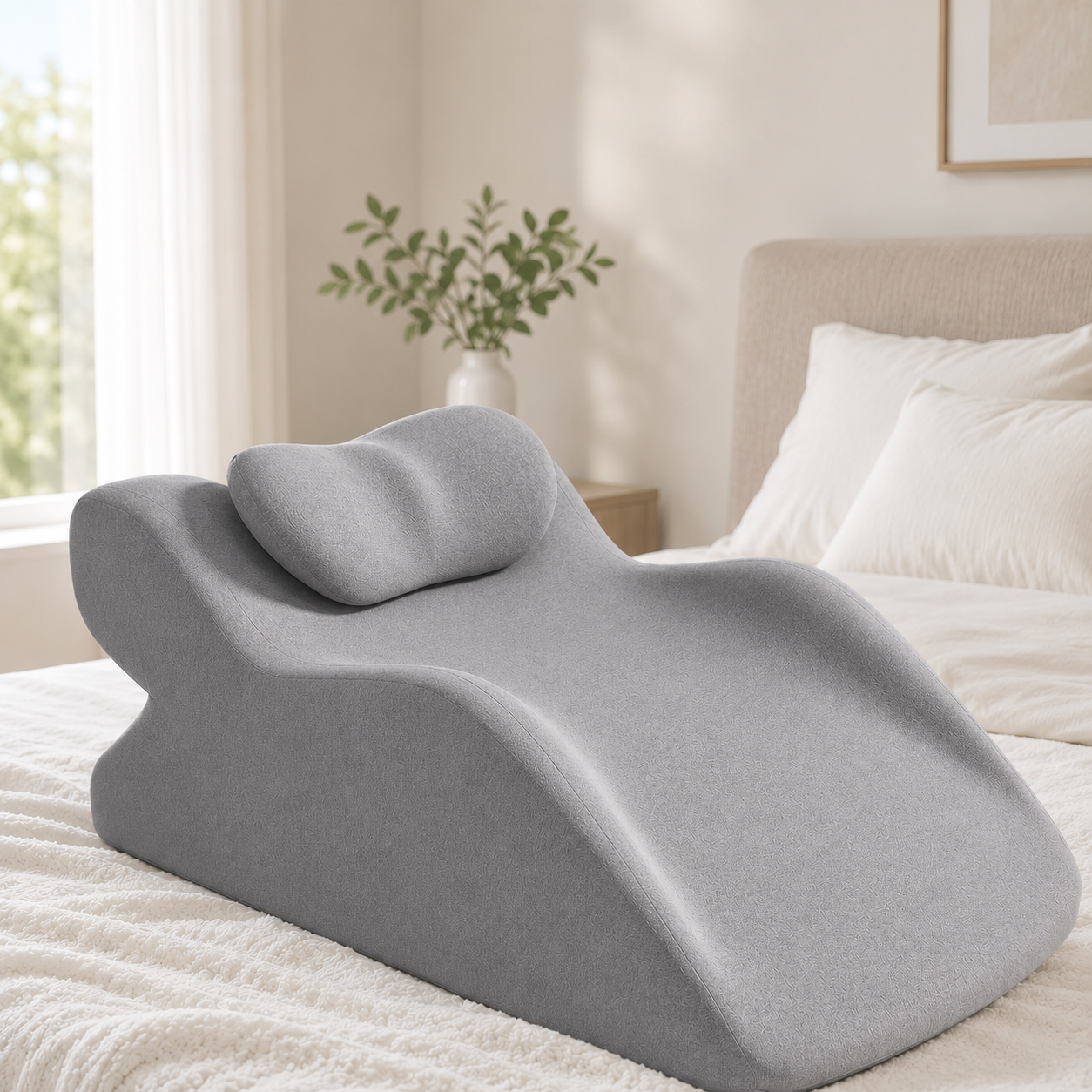
What actually holds: Fallowe is a fixed 27° support pillow built for one job - to hold your pelvis where your body would otherwise have to hold it. No protocol, nothing to build up to.
- High-density foam that doesn't compress - minute twenty feels like minute one
- Non-slip base, because repositioning is what restarts the loop
- Fixed 27°, not adjustable - the point is that you never manage it
- Rated to 300+ lb, removable washable cover over a moisture-resistant layer
#5
It looks like a cushion. Because between uses, that's exactly what it is.
Is part of your hesitation simply: what does the box say, and what if my daughter sees it?
The truth: For most women this isn't a footnote - it's the actual deciding factor. So it's built as a specification, not a reassurance.
- Plain outer box, no branding - a package on the porch, nothing more
- Neutral billing descriptor - nothing that needs explaining
- No badges, no anatomy, no shape that announces itself
- The same 27° works propped up to read, legs elevated, or as lower-back support
If a guest puts a coat on the bed, there's nothing to explain and nothing to hide.
And the one that stops most women
"That's all well and good - but it's been years for us."
This is where most women quietly count themselves out. Not because they doubt any of the above, but because they've decided they're the exception: too long ago, too old, he's stopped asking.
So the women below aren't in their forties. They're the age you actually are, after the years you've actually spent avoiding it.
"I stopped counting how long it had been. My only regret is how long I waited."
- [Name], 63 · [State]
"No aching the next day. That was the part that surprised me."
- [Name], 59 · [State]
"I didn't brace. I noticed afterwards that I hadn't."
- [Name], 66 · [State]
"It wasn't me. That's what I keep coming back to."
- [Name], 58 · [State]
And because "it's too late for us" is the quiet fear underneath all of this: among couples who did get help for this, a clear majority reported things were better than before menopause - not merely back to tolerable.
What it actually looks like
You'll know it worked because nothing happens.
No transformation arc. What women describe is an absence - of the flinch, of the aching afterwards, of the bracing.
Nothing hurts.
The load comes off. The first few seconds are simply uneventful - which, after years of bracing, is the whole thing.
No aching.
The part women mention most often is what doesn't happen the following morning.
You stop heading it off.
The excuses go quiet on their own - not because anything was decided, but because there's nothing left to avoid.
You stop counting how long it's been.
It goes back to being an ordinary part of your life instead of something you manage.
keep the pillow
neutral billing
no subscription
The Bolster - 27° Support Pillow
Built to hold, so you don't have to.
- Fixed 27° · high-density foam that doesn't compress
- Non-slip base · rated to 300+ lb
- Removable washable cover, moisture-resistant inner layer
- Ships in a plain box with a neutral billing descriptor
No countdown. No fake sale. It's the same price tomorrow.
Try it for 90 nights. Keep the pillow either way.
If it isn't right for you, email us for a full refund - and keep the pillow. Nothing to send back, nothing to package up. That's the whole policy.
What changes
Same body. One job fewer.
Before
- Bracing before anything has started
- Going to bed later so you don't have to say no
- Aching the next day
- Assuming it's you
After
- Nothing to brace against - the pillow holds the angle
- Nothing to head off, so the excuses go quiet
- No aching the following morning
- Knowing it was load, not you
The questions you're actually asking
Straight answers.
How do I bring this up with my husband?
Will anyone know? What does the box look like?
It's been years. Isn't it too late for us?
I've already tried lubricant. How is this different?
Can a pillow really make that much difference?
Will it hold my weight, or flatten?
Does it slide? Can I wash it?
How fast does it ship?
You don't need it to be like it was at thirty.
You need it to not hurt. That part is a load problem - and load problems are solved with support, not endurance.
Nothing dramatic happens if you close this page. That's exactly the difficulty: another quiet month, and "this is just how it is now" gets a little louder.
Get the pillow - $12990 nights · plain packaging · keep the pillow
Fallowe is a positioning support pillow. It is not a medical device and is not intended to diagnose, treat, cure, or prevent any condition, including dyspareunia or genitourinary syndrome of menopause. Prevalence figures describe the condition in the general population and are not claims about individual results. If sex is painful, it's worth raising with a clinician - this is common, and you deserve a real conversation about it.